Who talks most, leads
The research behind Roomy
Meetings are where work gets handed out: who owns the project, whose idea moves forward, who looks like the leader. Research shows how that is often decided. Not by the best idea, but by the most airtime.
Roomy exists because that pattern is measurable, it is unequal, and it costs everyone.
Meetings are where careers are made
Meetings are now a heavy, daily part of work. Microsoft's platform data shows people were in three times as many Teams meetings and calls per week in 2023 as in February 2020. Read AI's data puts the average at 12.9 hours of meetings a week, nearly a third of the working week.
Whatever happens in those meetings happens every day. And it adds up.
The person who talks most becomes the leader
Researchers call it the "babble hypothesis": how much someone speaks predicts whether a group sees them as its leader.
- 2020. In a study in The Leadership Quarterly, 256 people worked in 33 groups with no assigned leader. Speaking time predicted leadership nominations better than intelligence, task knowledge or personality, with a correlation of 0.67. Its effect held after accounting for intelligence, personality and gender.
- 2025. A follow-up in the same journal, with 38 teams, confirmed it: speaking more made others see the speaker as a leader. Once speaking time was accounted for, gender had little effect on who emerged as leader.
That second result is the key. When women get the airtime, they get the same leadership credit. The gap is in the airtime itself.
Women get less of the floor
- Interrupted twice as often. In McKinsey and LeanIn's Women in the Workplace 2023 survey of 27,000+ employees, about 1 in 5 women said they are interrupted or spoken over more than others, versus 1 in 10 men.
- Less credit. 21% of women said others get credit for their ideas, versus 14% of men: 1.5 times as often.
- Online, women's voice moves to the chat. A 2024 Microsoft Research study of real virtual meetings found that women take part more through the chat, and men more by speaking.
- Hybrid widens the gap. In Read AI's data, people in the conference room speak more than five times as much as people joining remotely.
Fewer turns, more interruptions, less credit. When airtime signals leadership, that becomes a leadership gap, built one meeting at a time.
From airtime to careers
Being seen as the leader in the room is how people get the next project, the stretch assignment and a sponsor. The career data shows where women fall behind:
- The broken rung. In 2025, only 93 women were promoted to manager for every 100 men. For women of color, the figure was 74.
- Fewer sponsors. 31% of entry-level women have a sponsor, versus 45% of men.
- Remote work costs women more. Women working remotely three or more days a week were less likely than men with the same setup to have been promoted in the past two years.
Meetings are not the only cause of these gaps. But they are where visibility gets built, and visibility is what promotion decisions run on.
Companies lose their best ideas
Unbalanced meetings are not only unfair. They waste talent companies already pay for.
- How a team collaborates makes it smarter. A 2021 meta-analysis in PNAS (22 studies, 5,279 people, 1,356 groups) found that a group's collective intelligence is predicted most by how its members collaborate, more than by individual skill. The share of women in the group was also a significant predictor of performance.
- Speaking is what makes people feel included. In a Microsoft study of real remote meetings across many organizations, taking part in the conversation was the strongest predictor of feeling included, with 4x higher odds. Meetings under eight people had 50% higher odds of being rated inclusive and 30% higher odds of being rated effective.
When the loudest voice wins, a company does not get its best idea. It gets its most confident one.
Making airtime visible changes behavior
Read AI analyzed 159,870 meetings. When its AI notetaker was present, women contributed about 9% more airtime relative to their share of attendees. Read AI notes this is a correlation, not proof that the AI caused it.
The same data shows women go off camera and on mute 19% more often than men. Still, the signal is simple: what gets seen starts to get balanced.
What Roomy does with this
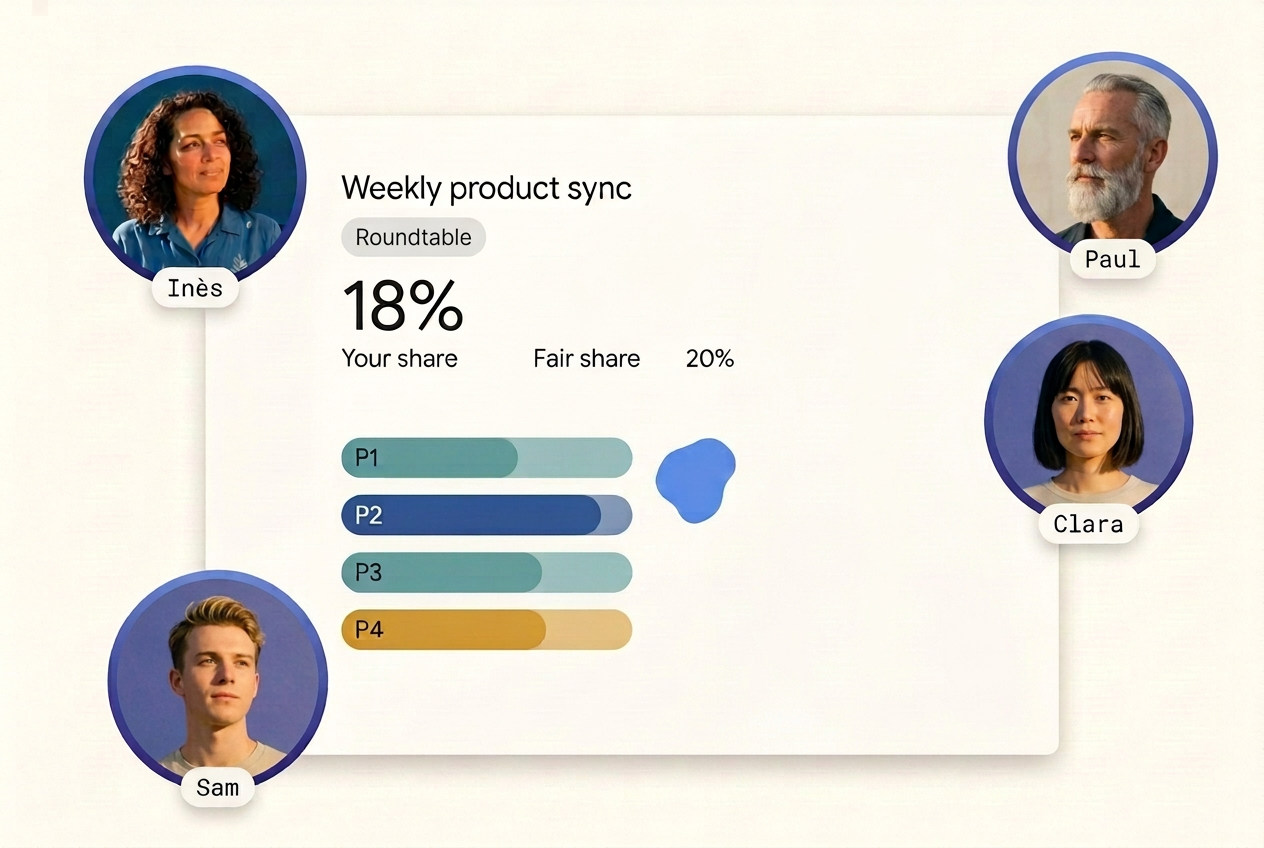
Roomy is a companion for Google Meet. It shows who is getting heard while the meeting is happening, not in a report afterwards.
- Live airtime, so you can take your space at the right moment.
- Private by design: no audio stored, no words stored.
- Built for women first, useful to the whole team: balanced meetings make better decisions for everyone in the room.
Room for every voice.
Get the extensionWhy we built it
Roomy's founder, Aurélia Zambon, has spent 20 years in male-dominated tech, including leading teams made up only of men. Since Covid, most of her meetings are video calls. She knows what it is like not to finish a sentence, and to watch an idea get picked up and credited to someone else.
Roomy turns that experience into data: facts, not drama. Because the best idea should win, not the loudest voice.
Sources
- MacLaren et al., Testing the babble hypothesis: speaking time predicts leader emergence in small groups, The Leadership Quarterly, 2020
- Loignon et al., Signaling with babble? Exploring the effects of gender and speaking time on leader emergence, The Leadership Quarterly, 2025 (LSU summary)
- McKinsey & LeanIn, Women in the Workplace 2023
- McKinsey & LeanIn, Women in the Workplace 2025
- Kreamer et al. (Microsoft Research), Virtual voices: individual differences in written and verbal participation in meetings, Journal of Vocational Behavior, 2024
- Riedl et al., Quantifying collective intelligence in human groups, PNAS, 2021
- Hosseinkashi et al. (Microsoft), Meeting effectiveness and inclusiveness in real-world remote meetings, CSCW 2024
- Microsoft, Work Trend Index 2023: Will AI fix work?
- Read AI, Power Dynamics in Meetings, 2026
- Rebecca Hinds, The hidden "taxes" women pay at work (Read AI data on meeting hours and in-room vs remote airtime)